
Buyer’s guide
Best Free Appliance Repair Software in 2026: 12 Tools, Ranked by the Cap on the Free Version
By Oleg Goriachev — owner, Cactus Appliance, Orange County, California; founder, Taskrol. Last reviewed . Each vendor carries the date its own pages were read, at the bottom.
The short answer
Three products here publish a free plan that doesn't expire: ServiceM8 Free for one technician on an iPhone who wants accounting sync and can live with a monthly job cap, Taskrol Solo for one appliance technician who wants unlimited jobs and a record of the machine, and Orcatec for a shop that wants a free scheduler with QuickBooks Online and will ask what the paid features cost. Menutize is a shape of its own: no clock and no seat limit, free until you send your first invoice or estimate, then one flat monthly price. Everything else is a trial with a clock, and ApplianceOps and Housecall Pro take no card for theirs, Jobber gives you 14 days of its Grow tier, Workiz gives you seven days, and LayCor adds a 30-day money-back window after its trial. Service Fusion, Smart Service, and ServiceTitan publish no free anything, and the last two won't show a price without a sales call.
I own Cactus Appliance in Orange County, California. Three technicians, about 150 jobs a month. I also built Taskrol, and one of its plans is free, so I have a stake in the word this page is about. The way I've handled that is the same as in the first roundup: my product is ranked second, not first, the argument for that place is written out, and every other product gets something named that it does better than mine.
This page answers one question. Not which tools are free, because that answer is short and it's in the box above. The question is what each free thing is capped by, and what happens on the day you hit the cap. That's the question a buyer searching for free software usually can't answer until the third month, when the trial has ended or the second technician has started.
Rules, as before. Every fact about another vendor comes from that vendor's own pages, read on the date next to its name, not from another listicle and not from memory. I don't quote anyone's prices, because a price goes stale inside a quarter; I describe the shape and link the page. Where a vendor's pages don't say something, I write not published, which is a different claim from doesn't exist.
Free means four things, and the cap is the product
Free means four different things in this category. The first is a free plan that stays free. Three products publish one: Taskrol Solo, which is one technician, one company, unlimited jobs, and no card; ServiceM8 Free, which is one user and a monthly cap on jobs; and Orcatec's free version, which includes dispatching and scheduling, GPS, call recording, commissions, and QuickBooks Online.
The second is a free trial, which is a paid product with a clock on it. Jobber gives you 14 days of its Grow tier. Housecall Pro gives you 14 days and asks for no card. Workiz gives you seven days. ApplianceOps has a trial with no card. LayCor has a 14-day trial and then a 30-day money-back window, which is a variant worth naming: a paid month you can undo.
The third is the one I didn't have a name for until I read Menutize's page: free with no clock and no seat limit, ended not by a date but by an action. Theirs is that the monthly price starts when you send your first invoice or estimate. Nothing counts down, so you can load your customers and learn the product over a month of evenings. But billing is the one thing a repair shop cannot do without, so you will hit that cap on your first real job. Read it next to a 14-day trial and decide which you'd rather have: two weeks of everything, or forever of everything except the part that pays you.
The fourth is no free anything. Service Fusion's pages mention no trial. ServiceTitan is sold by quote through a demo, and Smart Service is sold by quote, so the first number you see arrives after a conversation with a salesperson.
Which one is free is the short question. The long one is what the free thing is capped by, and there are five kinds of cap on this list. A cap on technicians, which is ours. A cap on jobs per month, which is ServiceM8's. A cap on an action, which is Menutize's: bill anybody and the price starts. A feature you only find out you needed after you needed it, which is what a trial of one tier or a free version of a modular product amounts to. And a clock. The day you hit the cap is the day the software gets a price, and the shape of that price is the thing to read before you sign up for anything.
Where the appliance record lives, which is the other question this category turns on, is the first roundup's job, and it's ranked there for seventeen products.
That's the test every product here is measured against: what is the free thing capped by, is the cap published, and what does the day you hit it look like.
The table
Shape, not prices. “Not published” means the pages I read don’t mention it; it doesn’t mean the feature doesn’t exist.
| Product | What's free | The cap | The day you hit it | Behind the paywall | Card to start | Runs on |
|---|---|---|---|---|---|---|
| 1. ServiceM8 | A free plan, not a trial: one user | One user and a monthly job cap | Paid tiers priced by monthly job volume, unlimited users | Asset Management from the Growing tier; forms and job costing gated by tier | Not published | iOS first; Android “Lite” |
| 2. Taskrol | Solo: a free plan, no expiry, one technician | One technician, one company, and no one can be invited; jobs and customers unlimited | Basic is flat and invites unlimited subcontractors on their own subscriptions; a second technician on your payroll means Pro, flat, three users included | Full web reporting, warehouse inventory, manuals and diagrams, AI invoices, company-wide shopping list, team seats | No | Web, iOS, Android |
| 3. Orcatec | A free version: dispatch and scheduling, GPS, call recording, commissions, QuickBooks Online | Not published; paid features are by request | Paid pricing by request; you pay for the features you pick | Not published; the pricing page is a contact form | Not published | Web, iOS, Android |
| 4. ApplianceOps | A trial, no card; length not published | The clock | Base plus per seat, capped for a five-person shop; every feature on every plan | Nothing gated by plan; phone system is an add-on | No | Browser, Android app, iOS as web app; full offline |
| 5. Housecall Pro | 14-day trial, no card | The clock: 14 days | Three tiers with seats included, extra seats billed, add-ons on top | Route optimization, recurring plans, API on the top tier; CSR AI, Voice, Campaigns, Payroll, GPS as add-ons | No | Web, iOS, Android |
| 6. Menutize | Everything except billing, for as long as you like | Your first invoice or estimate | One flat monthly price, one seat included; teammates priced per seat | Nothing extra — the whole product is on the one price | No card required | Not published |
| 7. LayCor | 14-day trial, then a 30-day money-back window | The clock: 14 days, then a month you can refund | Flat monthly plans, unlimited team members, add-ons | A long menu of small add-ons | Not published | Browser-based mobile |
| 8. Jobber | 14-day trial of the Grow tier | The clock: 14 days, on a tier you may not buy | Four tiers with seats included, extra seats billed monthly | QuickBooks Online from Connect; job costing on Grow; AI receptionist and marketing as add-ons or Plus | Not published | Web, iOS, Android |
| 9. Workiz | Seven-day trial | The clock: seven days | Standard, Pro, Ultimate, feature-gated, plus Genius add-ons | Inventory and POs on Ultimate; custom reports from Pro; Genius Phone, Answering, Marketing as add-ons | Not published | Web, iOS, Android |
| 10. Service Fusion | Nothing; no free trial mentioned | None to hit; paid from day one | Three flat tiers, unlimited users, annual discount | Inventory and job costing on Plus; GPS and ServiceCall.ai as add-ons | No trial mentioned | Web, iOS, Android |
| 11. Smart Service | Nothing published; sold by quote | None to hit; the quote | Quote-based subscription, Standard or Enterprise, onboarding and data conversion bundled | Not published; what separates Standard from Enterprise isn't on the site | Quote-based; trial not published | Cloud or Windows desktop; iFleet app |
| 12. ServiceTitan | Nothing published; quote through a demo | None to hit; the per-technician quote | Per technician, quote only, three packages plus Pro add-ons | Mobile estimates above Starter; advanced reporting, commissions, memberships on The Works; Pro products on top | Quote through a demo; trial not published | Web, iOS, Android |
How I judged them
The order is about the cap, not the product. First by honesty: is the cap published, in users, jobs, days, or features, or does it arrive as a quote? Then by survivability: how long can a working shop live inside it, and what shape does the bill take on the day it stops fitting? A free plan with a published cap ranks above a trial. A trial with no card ranks above a trial that doesn't say. A published pricing shape with no trial ranks above a quote. If you want the products ranked as products, that's the first roundup; this page puts a general booking platform above Jobber because its trial is longer and you can undo the first month, and that's the right answer to this question and the wrong answer to the other one.
Two products are first-hand: Housecall Pro, which Cactus ran on for years, and Taskrol, which it runs on now. Everything else is documentation, read from the vendor's own pages on the date next to its name. Where a page doesn't say whether a card is needed or how long a trial runs, the table says not published, and I'd rather leave that cell honest than fill it from memory.
The list
1. ServiceM8
Documentation-based · pages read
ServiceM8 is built for sole traders up to 20 staff, and it prices by job volume instead of seats. The free plan is one user with a monthly cap on jobs. The paid plans have unlimited users and rising job limits. Xero, QuickBooks Online, and MYOB sync on every plan.
That's the most honest cap on this list, and I'm putting it above my own. A cap on jobs is a cap that tracks money coming in: you pay when you're busy enough to pay. And when you do pay, users are unlimited, so the second technician and the dispatcher don't change the bill. Ours does.
- Where the appliance lives
- In Asset Management, an add-on from the Growing tier, which is above Free: asset type, location on site, custom fields, photos, and a QR label you stick on the machine. It was designed around fire extinguishers and air conditioners on commercial sites. Nothing on their pages describes parts or inventory.
- Better than Taskrol
- Three accounting integrations on every plan where we have none, paid tiers with unlimited users so hiring costs nothing in software, Tap to Pay on iPhone, and a cap that scales with the shop: paid tiers with unlimited users, where our seats are counted per employee and a second one on the payroll means Pro.
- Watch for
- iOS first is a hard constraint for an Android tech; the Android app is a Lite version carrying the basics. A busy solo tech outgrows the free plan's job cap fast, so know your monthly job count before you count on Free. Whether a card is needed to start isn't published. Nothing on their pages describes parts or inventory, on any plan.
- Pricing shape
- Free plan with one user and a monthly job cap; paid tiers by monthly job volume with unlimited users; Asset Management, forms, and job costing gated by tier. Their pricing page →
- For
- A solo tech with an iPhone, an accountant on Xero or QuickBooks Online, and a job count that fits the cap.
2. Taskrol
First-hand · pages read
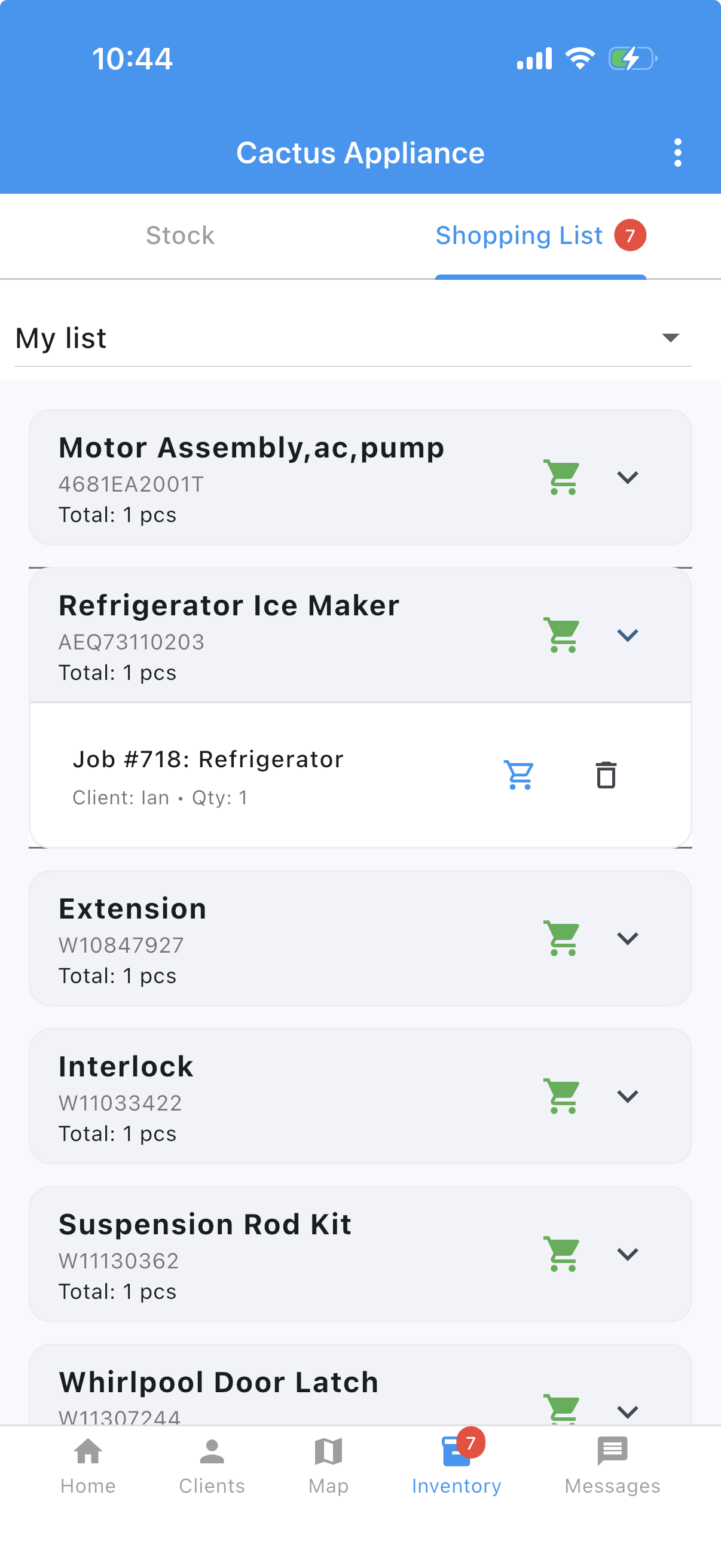
Solo is free for one technician and one company, with unlimited jobs and unlimited customers, and no card to start. It doesn't expire. What you get is the working set for a one-person shop: schedule, map, parts, invoices, card payments, a personal van inventory, a personal shopping list, and core reports in the mobile app.
The cap is a person, and it's worth being exact about which person. On Solo you can't invite anybody at all, not a technician and not a subcontractor. Inviting people starts on Basic, and from there the rule is simple: a seat is somebody on your payroll. Subcontractors aren't seats. A subcontractor pays for his own Taskrol subscription and connects to your company from it, so you can work with as many as you can find, on Basic or on Pro, and none of them change your bill. Put a second technician on your own payroll, though, and Basic doesn't stretch, because it's one seat, and the answer is Pro: a flat monthly price with three users included rather than per seat. So the step is a cliff if you hire and no step at all if you subcontract. The placement note below says why I still think this is the second most survivable cap on the list.
One more thing that's true. A free plan from a company that needs you to outgrow it is a different promise from a free plan at a company big enough not to care. We're the small one here. Solo is free because a solo tech who runs a real week on it is the person most likely to hire someone and pay us. I'd rather say that than have you work it out in month three.
- Where the appliance lives
- On the job and in the customer's history: brand, model, and serial per unit, with every visit, part, invoice, and callback attached to that unit. Solo's published list covers the schedule, the map, parts, and invoices. What Solo doesn't have is the shared company warehouse the parts search also looks in, which is Pro, and the manuals and exploded diagrams on the job, which start on Basic. On Solo the search shows your own van, by cell.
- Better than the rest of this list
- A free plan with no job cap and no clock, on any phone, that records the machine and shows what's on the van. Whether that outweighs what's missing depends on your headcount and your bookkeeper.
- Watch for
- Reporting is trimmed on Solo: core reports in the mobile app, with full reporting on the web a paid feature. No QuickBooks sync in either direction, on any plan, so if your bookkeeper lives there, ServiceM8 and Orcatec both publish one at zero and we don't at any price. No OEM or home-warranty dispatch. The design is behind the funded incumbents. Almost no public reviews, because the product is new. And the cap is a person. Solo invites nobody at all — not a technician, not a subcontractor — so the day you stop working alone you are on a paid plan whichever route you take. Hire onto your own payroll and Basic's single seat doesn't stretch, so it's Pro. Work with subcontractors instead and Basic covers any number of them, because each one pays for his own subscription. Hold that against how you actually plan to grow.
- Pricing shape
- Solo is free for one technician and one company, unlimited jobs, no card. Basic is a flat monthly price for one seat. Pro is a flat monthly price with three users included, not per seat. SMS is unlimited. Statistics, telephony, and AI invoice drafting are optional add-ons. Paid plans include a 7-day trial. Their pricing page →
- For
- A one-person appliance shop that needs a part on most calls, wants no bill and no clock, and can live without QuickBooks.
Why second and not first: ServiceM8's cap is a job count, and its paid tiers have unlimited users, so growing there is a slope. Growing here is a cliff at the second technician you put on your own payroll — subcontractors don't count against seats, because each one pays for his own subscription, but a hire does — and a company my size needs you to reach that cliff. Why second and not third: Orcatec's free version includes more than Solo does, QuickBooks Online among it, but its cap isn't published and its paid pricing is a contact form. This page ranks caps you can see, and ours is written down: one technician, one company, unlimited jobs, no card, no clock.
3. Orcatec
Documentation-based · pages read
Orcatec is all-in-one home-services software from Rancho Santa Fe, California, covering fifteen trades including appliance repair, with a free version. What the free version includes is the richest list at zero on this page: dispatching and scheduling, GPS, call recording, commissions, and QuickBooks Online. We bundle none of that free, and QuickBooks we don't have at all.
What it's capped by is the problem. The site says you pay only for the features you pick, and the pricing page is a contact form. So the free version has a ceiling, and you find out where it is by asking. That's an honest model and an unreadable one, and it's why the richest free plan here is third rather than first.
- Where the appliance lives
- In a custom form on the job, with fields for problem description, model, and serial number. A step above a text note and a step below a record with history. A spare-parts inventory and a supplies-order feature are on the appliance page; which plan they sit on isn't published.
- Better than Taskrol
- A free version that includes dispatching and scheduling, GPS, call recording, commissions, and QuickBooks Online, none of which we bundle at zero, and a QuickBooks sync we don't publish at any price.
- Watch for
- The pricing page is a contact form, so the cap on the free version, and what the day you hit it costs, are both things you learn from a salesperson. Whether a card is needed to start isn't published. Warranty-network dispatch isn't published. The appliance record is a form, not a history.
- Pricing shape
- Free version; paid pricing by request, modular, pay for the features you pick. Their pricing page →
- For
- A shop that wants a free scheduler with QuickBooks Online, will build the appliance record itself, and doesn't mind a phone call to learn the price.
4. ApplianceOps
Documentation-based · pages read
ApplianceOps is the CRM built only for appliance repair, by a technician with nearly two decades in the trade, for a one-man operation up to a five-person store. There's no free plan. There is a trial with no card, and the thing that puts it at the top of the trials is a pricing rule: every feature is on every plan.
That matters more than it sounds. A trial of a tiered product shows you a tier, and the feature you fell for may sit on the one you won't buy. A trial of ApplianceOps shows you ApplianceOps. The clock is the whole cap, and when it runs out the price is a base plus per seat, with no cut taken from card payments.
- Where the appliance lives
- On the invoice. Each machine on a call gets its own invoice block, priced by type, with a service history per machine, and parts run through an append-only stock ledger with a Parts-to-Order roll-up. That's the appliance record done properly, and the trial shows all of it.
- Better than Taskrol
- Every feature on every plan, so the trial is the product. Full offline invoicing, payment capture, and signatures. Home-warranty split billing with dispatch emails from AHS, First American, Choice, and ServicePower parsed into work orders. No cut of card payments.
- Watch for
- How long the trial runs isn't published on the pages I read, so ask before you start entering a week of jobs. The field app is Android from Google Play or a browser install on anything else, with no native iOS app. QuickBooks Online is a nightly bulk push. It's a small team by its own description, and I couldn't find independent reviews. I have not run it.
- Pricing shape
- Trial with no card; then a base price plus per seat, capped for a five-person shop and per seat beyond, every feature on every plan, phone system as a separate add-on, no cut of card payments. Their pricing page →
- For
- A one-to-five-tech shop that does home-warranty work and wants to try the whole product before paying for any of it.
5. Housecall Pro
First-hand · pages read
Cactus ran on Housecall Pro for years before Taskrol existed, so this one is first-hand. There's no free plan. The trial is 14 days and asks for no card, which is the honest shape for a trial: the clock runs out and nothing converts on its own.
What's on the other side of the clock is the reason it isn't higher. Basic includes one user. Essentials and Max include a block of seats, and additional users are billed monthly, so the dispatcher is a seat. Route optimization, recurring service plans, and API access sit on the top tier, and CSR AI, Voice, Campaigns, Payroll, and GPS are each their own line. The trial shows you a product; the bill shows you a stack.
- Where the appliance lives
- In Property Profiles, an app you switch on under My Apps: item type, make, model, serial, and install date per address, attachable to jobs. From the documentation the record doesn't connect to parts or stock, and the appliance page doesn't mention inventory. Our techs photographed stickers anyway.
- Better than Taskrol
- The consumer-facing surface: online booking, reminders, review management, campaigns, a website product, Instapay deposits, and a published card-processing rate that undercuts ours. QuickBooks sync, which we don't have. And a 14-day trial with no card, which is exactly how a trial should be shaped.
- Watch for
- The trial ends into a seat count. Count your dispatcher before you compare tiers, and add every add-on you'd switch on in the first month, because the advertised price and the paid price drift apart with each one. Nothing here is free after day 14.
- Pricing shape
- 14-day trial without a card; then three tiers with seats included, extra seats billed monthly, and a long list of add-ons. Their pricing page →
- For
- A multi-trade home-service business that wants to try the most polished booking and marketing surface here for two weeks without giving a card.
6. Menutize
Documentation-based · pages read
Menutize is the only product here whose free version isn't bounded by a clock or a seat count. Their page puts it plainly: sign up free, no card, and the monthly price starts when you send your first invoice or estimate. So you can load your customers, learn the thing, and run it alongside whatever you use now, for as long as you want.
That's a fourth shape of free, and it's the tightest cap on this page, because billing is the one thing a repair shop cannot do without. You will hit this cap on your first real job. It sits here rather than lower because of what happens that day: one flat monthly price with a seat included, and no annual commitment. That is the softest and most predictable landing on the list, and you got to make the decision with the whole product in front of you instead of against a countdown.
- Where the appliance lives
- Not published. The customer record holds unlimited photos per customer, which is the closest thing on their page to a machine history, and photos of a data plate are how a lot of shops actually store a model number. Nothing on the page describes parts, van inventory, or a record of the appliance itself.
- Better than Taskrol
- A diagnostic deposit collected at the moment of booking rather than at the door, Good/Better/Best tiered estimates, automated Google review requests by text, tip prompts at checkout, open-tracking so you know the customer read the estimate, recurring maintenance-plan billing, two-way Google Calendar sync, and ACH priced as a small capped percentage, which on a big sealed-system job costs a lot less than a card. Their second seat is a per-seat line; ours is a plan change.
- Watch for
- The page is titled "Free Appliance Repair Software, Forever," and the free part ends at your first invoice or estimate. Read that sentence before you plan around the word forever. Their two pages also put the line in different places: the appliance page says the price starts at your first invoice or estimate, while the front page offers a few free estimates and starts the price at the first invoice. Ask which it is before you count on either. Card processing is charged on top of the subscription at the usual card rate, and the ACH cap is worth checking against your average ticket. Parts and inventory aren't published anywhere on the page, and for appliance repair that's the half of the job that happens after the diagnosis — check it before you move. Which platforms it runs on isn't published either.
- Pricing shape
- Free until your first invoice or estimate, then one flat monthly price with a seat included, teammates per seat, plus card and ACH processing fees. Their pricing page →
- For
- A solo tech who wants to collect a deposit at booking and be paid by ACH, and who tracks parts somewhere else.
7. LayCor
Documentation-based · pages read
LayCor is a booking-and-scheduling platform for service businesses in general, with sixty-plus industry solutions and an appliance repair page on top. It's here because its free shape is the most generous of the trials: a 14-day trial, then a 30-day money-back window, on flat monthly plans with unlimited team members.
Add those up and you get about six weeks to decide, with the second half refundable, on a price that doesn't move when you hire. On this page's question that beats Jobber and Workiz. On the first roundup's question it didn't, and the reasons are in the watch-for line.
- Where the appliance lives
- With the property: brand, model, service history, and warranty status, captured at booking when the customer picks appliance type and brand. Dispatch can assign by technician specialty and brand certification. Parts are tracked per truck. It's an appliance template on a general product.
- Better than Taskrol
- A 30-day money-back window on top of the trial, flat pricing with unlimited team members so the second technician is free in software, dispatch by brand certification at the moment of booking, and QuickBooks Online.
- Watch for
- The outcome numbers on the page, such as 35% more bookings in month one, are claims I can't check any more than you can. Whether a card is needed to start isn't published. The appliance layer is a template on a general booking product, so use the trial to open the parts and the appliance record before the booking widget. The add-on menu is long; price the ones you'd use.
- Pricing shape
- 14-day trial, 30-day money-back window, flat monthly plans with unlimited team members, a long menu of small add-ons. Their pricing page →
- For
- A small crew that wants a branded booking page, a flat price, and six weeks to change its mind.
8. Jobber
Documentation-based · pages read
Jobber has no free plan. It has a 14-day trial of Grow, its third tier of four, and that detail is the whole entry. Grow is where job costing lives. Core, the entry tier, includes one user; Connect, Grow, and Plus include blocks of five, ten, and fifteen users, with additional users billed monthly.
So the trial shows a solo tech a product with job costing and a block of ten seats, and the tier that solo tech is likely to buy is Core, with one user and without it. That's the feature-you-only-miss-once-you-need-it cap in its purest form. Nothing about it is dishonest. It's a trial of the wrong tier for most people reading this page, and the fix is to know that going in.
- Where the appliance lives
- In custom fields, text, number, or dropdown, on clients, properties, quotes, jobs, and invoices, available on select plans. There's no equipment module, and the appliance page describes no parts or inventory. Which plans have custom fields is the thing to check during the trial.
- Better than Taskrol
- Client Hub, the 24/7 portal where customers approve quotes, see appointments, and pay. QuickBooks Online from the Connect tier. The best-reviewed app here by its own numbers, and the easiest to hire a dispatcher for.
- Watch for
- The trial is of Grow, so write down which features you used and check which tier each one sits on before you pick a plan. Whether a card is needed to start isn't published. Seats are included in blocks and extra users are billed monthly, so the dispatcher counts.
- Pricing shape
- 14-day trial of Grow; then four tiers with seats included, extra seats billed monthly, annual discount. Their pricing page →
- For
- A small team that wants the smoothest customer experience and will use the trial to learn which tier it actually needs.
9. Workiz
Documentation-based · pages read
Workiz has no free plan and the shortest clock on the list: seven days. Its appliance page is about the phone and the leads: a built-in phone system, Genius AI Answering that books emergency callers around the clock, and integrations with Angi, Thumbtack, and Google's Local Services Ads.
Seven days is enough to see the phone system and not enough to see a month of jobs. And the modules an appliance shop would want to test, inventory and purchase orders, sit on the Ultimate tier, with custom reports starting at Pro and the Genius products as add-ons, so plan the week before you start it.
- Where the appliance lives
- Nowhere described. The appliance page doesn't mention make, model, or serial. Inventory tracks which parts are in stock and what's running low, and it sits on the Ultimate tier only, alongside purchase orders and service plans.
- Better than Taskrol
- QuickBooks sync on every tier, the phone system inside the CRM with the call recorded against the job, and Angi, Thumbtack, and Google Local Services Ads wired in as lead sources.
- Watch for
- Seven days. Decide what you need to see before day one, and make sure the trial is on a tier that has it, because inventory and purchase orders are Ultimate only. Whether a card is needed isn't published. The Genius products you'd switch for are add-ons.
- Pricing shape
- Seven-day trial; then Standard, Pro, Ultimate, feature-gated, with add-on Genius products. Their pricing page →
- For
- A shop that lives on marketplace leads, wants the phone inside the CRM, and can decide in a week.
10. Service Fusion
Documentation-based · pages read
Service Fusion's pages mention no free trial, so there's no free thing to cap. It's here, above the two quote-only products, because the price has a published shape: three tiers, Starter, Plus, and Pro, all with unlimited users at a flat price, with onboarding and unlimited phone support included on every plan.
For the cap question that's a clean answer. There's no clock and no seat count; you pay from day one, and the second technician and the dispatcher don't change the bill. For a two-tech shop it's a flat price for an office you don't have.
- Where the appliance lives
- Not on the appliance page, which covers scheduling, estimates, a customer web-booking portal, pre-job texts, eSignature, and payments, with no make, model, or serial and no parts. Equipment tracking appears elsewhere in their feature marketing; I couldn't find what a record holds. Inventory arrives on Plus.
- Better than Taskrol
- Unlimited users at a flat price on every tier, so three techs and two office people pay the same as three techs alone, plus bi-directional QuickBooks and onboarding and unlimited phone support included on every plan.
- Watch for
- No free trial is mentioned, so the first month is a paid month. The flat price is a flat price for a full office. Inventory management and job costing arrive on Plus, and GPS fleet tracking and ServiceCall.ai are add-ons. Ask whether a demo account exists before you commit.
- Pricing shape
- No trial mentioned; flat, unlimited users, three tiers, annual discount, add-ons for VoIP and GPS. Their pricing page →
- For
- An office-heavy shop where dispatchers outnumber technicians, the books live in QuickBooks, and nobody needs a free month to decide.
11. Smart Service
Documentation-based · pages read
Smart Service publishes no free plan and no trial that I could find. Pricing is quote-based, Standard or Enterprise, and the quote bundles onboarding and data conversion, with support renewed annually. Their reasoning is that a two-truck shop and a fifty-tech operation shouldn't pay the same, which is fair, and which means you can't size it from the website.
On this page's question that puts it near the bottom, and that's not a judgment of the product. It's the answer when your bookkeeper won't leave QuickBooks Desktop, and the appliance record is per unit and properly done. It isn't free in any of the three senses, and the first number arrives after a conversation.
- Where the appliance lives
- Per unit, properly: individual records for washer, dryer, refrigerator, range, and dishwasher with make, model, and serial, service history, warranty status and expiration, parts usage, photos, fault codes, and model-plate photos captured at the job. Inventory visibility before dispatch is stated; how deep it goes isn't.
- Better than Taskrol
- The accounting seat: built around QuickBooks rather than bolted onto it, Desktop included. A per-unit appliance record with warranty status. Skill-based technician assignment. Onboarding and data conversion bundled into the quote, which is a cost we leave to you.
- Watch for
- No trial or free plan is published, so you'll be evaluating from a sales conversation rather than from your own week of jobs. The quote bundles onboarding and data conversion and support renews annually, so ask for the year-two number as well as the year-one number.
- Pricing shape
- Quote-based subscription, Standard or Enterprise, annual discount, onboarding included; a desktop licence option exists. Their pricing page →
- For
- A shop whose books are already in QuickBooks Desktop and whose owner would rather take a sales call than change the accountant.
12. ServiceTitan
Documentation-based · pages read
ServiceTitan is priced per technician, sold by quote through a demo, and its pages publish no free plan and no trial. Three packages, Starter, Essentials, and The Works, with Pro products layered on top. It's the right answer for a different-sized business than the one searching for free software.
It's last on this page for the plainest reason on it: there is no free thing, the price is per technician, and it arrives after a demo. For ten-plus technicians with a controller and a warehouse, none of that is a problem. For the reader this page is for, all of it is.
- Where the appliance lives
- In job histories and equipment records, with an inventory side that is real: multiple locations across trucks and warehouses, purchase orders, transfers, barcode scanning, and automatic replenishment. It's the deepest stock system here and the furthest from free.
- Better than Taskrol
- Purchasing: purchase orders, vendor returns, transfers between locations, barcode receiving. QuickBooks Desktop Premier and Enterprise alongside Online. Capacity planning for a real office. Everything we don't do, at the size we don't serve.
- Watch for
- Per-technician pricing by quote, so the first number you see comes after a sales call, and for a two- or three-tech shop it buys capacity you won't use. Mobile estimates sit above Starter, and advanced reporting, commission tracking, and memberships sit on The Works.
- Pricing shape
- Per technician, quote only, three packages plus Pro add-ons; no trial published. Their pricing page →
- For
- Ten-plus technicians with a controller and a warehouse, for whom a free month was never the question.
The day you hire the second technician
This is the article's own question turned on its author, so here it is plainly. Solo is one technician and one company, and it invites nobody: not an employee, not a subcontractor. Basic adds AI invoices, manuals and diagrams, warehouse inventory, and full reporting, and it is where inviting starts — but it is still one seat, and a seat means somebody on your payroll. Subcontractors are outside that count entirely. A subcontractor runs his own Taskrol subscription and connects to your company from it, so you can work with as many as you can find without the bill moving. Put a second technician on your own payroll and the plan that fits is Pro: a flat monthly price with three users included, not per seat, with the shared company warehouse, the company-wide shopping list, technician scheduling and assignment, and roles and permissions.
So the slope from free to paid at Taskrol has one step in it, and the step is a person. Compare that with ServiceM8, where the step is a job count and the paid tiers have unlimited users, or Service Fusion and LayCor, where users are unlimited from the start. Ours is the cliff on this list. It's a cliff at a flat price, and Cactus runs three technicians on it for a figure the section below works out as a share of revenue, but it's still a cliff, and I'd rather you saw it here than on the day it matters.
What Solo includes and excludes, line by line, is on the Solo plan page. This page ranks the field; that one sells the plan, and I've tried to keep the two jobs separate.
What the free tier holds back
Every free plan and every trial on this list holds something back, and the honest ones say what. On Solo it's reporting: core reports in the mobile app, with full reporting on the web a paid feature, and the shared warehouse, manuals and diagrams, and AI invoices behind it. On ServiceM8 Free it's the job cap, with Asset Management, forms, and job costing gated by tier above it. On Orcatec it's whatever isn't in the free feature list, and what that costs is by request.
The trials hold back differently. Jobber's trial is of Grow, so what it holds back is the knowledge of which tier your favorite feature lives on. Workiz holds back time, and puts inventory and purchase orders on Ultimate. Housecall Pro holds back the top tier's route optimization, recurring plans, and API, and every add-on. ApplianceOps holds back nothing by plan, which is why it leads the trials. LayCor's add-on menu is long, and the trial is the time to find out which of them you'd switch on.
A feature you only miss once you need it is a cap. It's the one kind that doesn't show up in the table until you've hit it, which is why the table tries to name them.
Free from a small company, free from a big one
There's a difference between a free plan from a company that needs you to outgrow it and a free plan from a company big enough not to care, and the buyer should know which one they're on. ServiceM8 is built for sole traders up to 20 staff and prices by job volume; a free user who stays small isn't the business model. Orcatec covers fifteen trades and sells paid features by request; the free version is a front door to a modular product. Housecall Pro, Jobber, and Workiz don't publish a free plan at all, and their trials are marketing with a clock.
Taskrol is the small one. Solo is free because a solo tech who runs a real week on it is the person most likely to hire someone and pay us, and I'd rather write that down than have it dawn on you in month three. What that promise is worth: the plan is published as no expiry and no card, the cap is written down, and the paid step is flat rather than per seat. What it's not worth: a guarantee that a company of our size has the incumbents' polish, their reviews, or their QuickBooks sync. It doesn't, and the Taskrol entry above says so.
How to run a trial so it answers the question
Whichever trial you start, treat it as a week, not a demo. Put in real jobs from last week, with the real customer, the real machine, and the real part. Make the trial do the thing your shop actually does, which for us is order a part on nearly every call. A trial you run on sample data tells you what the sales page already told you.
Then, before the clock runs out, find the cap on purpose. On a free plan, add a second user, or add jobs until you reach the monthly number. On a trial, write down every feature you used and check the pricing page for which tier each one sits on. If the trial was of a tier you won't buy, you now know which of those features leaves with it. If a vendor's pages don't say whether a card is needed to start, the signup form will, and that's worth knowing before you type anything.
What a three-technician shop actually pays
The sticker price and what you pay are usually different numbers, and the difference has a shape. Seats are counted separately, and the office dispatcher is often a seat too. Reporting frequently sits one tier above where the advertised price sits. The technician app can be its own line. Phone, AI answering, and marketing are add-ons almost everywhere. Card processing is a percentage nobody puts in the headline.
I’m not going to quote the other vendors’ numbers — see the rule above — so the shapes are in the table and each product’s pricing page is linked from its card. Our own number is mine to quote: Cactus runs 3 technicians and about 150 jobs a month at an average ticket of $360, so the shop turns about $54,000 a month. Taskrol Pro costs $129 a month, flat, with 3 users included — not per seat. Card processing is 3.4% + $0.30 per successful card transaction and SMS is unlimited. That’s 0.24% of revenue for the system the whole shop runs on. Hold every other product against that yardstick, because a per-seat tool at three seats plus a dispatcher lands somewhere very different.
Which one, for which shop
- One tech, an iPhone, an accountant on Xero or QuickBooks Online
- ServiceM8 Free, and know your monthly job count before you count on it.
- One tech, any phone, a part on most calls, no bill and no clock
- Taskrol Solo. The day you hire, it's Pro, flat, three users included.
- You want a free scheduler with QuickBooks Online and will make the call to learn what paid costs
- Orcatec.
- One to five techs, warranty work, and you want to see the whole product before paying
- ApplianceOps. No card, every feature on every plan, so the trial is the product.
- Multi-trade, the phone isn't ringing, two weeks and no card
- Housecall Pro. Count the dispatcher's seat before you compare tiers.
- You'd rather pay a flat price and keep the option to undo the first month
- LayCor: 14-day trial, then a 30-day money-back window, unlimited team members.
- You want the smoothest app and will pay per seat
- Jobber. Remember the trial is of Grow; check which tier your favorite feature lives on.
- Marketplace leads, a phone inside the CRM, and you can decide in a week
- Workiz. Seven days; make sure the trial tier has inventory if you need to see it.
- More office users than technicians, no free month needed
- Service Fusion. No trial mentioned, flat, unlimited users.
- Bookkeeper on QuickBooks Desktop
- Smart Service, by quote, with onboarding bundled.
- Ten-plus technicians
- ServiceTitan. Free was never the question.
Whichever trial you start, do one thing before the clock runs out: put in a real week of jobs, then hire an imaginary second technician. Add the user, assign them tomorrow's first call, and look at what the bill becomes. If the answer takes a sales call, you've learned what the free version was for.
Frequently asked questions
- Is there appliance repair software that is free forever?
- Three products on this list publish a free plan rather than a trial: Taskrol Solo (one technician, one company, unlimited jobs, no card), ServiceM8 Free (one user, a monthly job cap), and Orcatec's free version (dispatch, scheduling, GPS, call recording, commissions, QuickBooks Online).
- What is the difference between a free plan and a free trial?
- A free plan stays free until you hit its cap, a user count or a job count. A free trial is a paid product with a clock; when the clock runs out, the price arrives. Ask which one you're on before entering a week of jobs.
- Does Taskrol's free plan expire?
- No. Solo has no clock and needs no card: one technician, one company, unlimited jobs and customers. The cap is strict, because Solo can invite nobody, employee or subcontractor. Inviting starts on Basic. Hire a second technician onto your payroll and the plan that fits is Pro.
- Does a subcontractor use one of my seats in Taskrol?
- No. A subcontractor runs his own Taskrol subscription and his own company, and you invite him onto your team from it, so he never takes one of your seats. Work with as many as you like. Seats count only your payroll, and inviting anyone starts on Basic.
- What is the catch with Taskrol Solo?
- Reporting is trimmed to core reports in the mobile app, the shared warehouse and manuals are paid, there is no QuickBooks sync on any plan, no warranty-network dispatch, and the company is small and new. The catch is that we need you to outgrow it.
- Which appliance repair software offers a free trial without a credit card?
- Housecall Pro publishes a 14-day trial with no card, and ApplianceOps a trial with no card. Taskrol Solo needs no card and has no clock. Jobber, Workiz, ServiceM8, Orcatec, and LayCor don't say on the pages I read, so check the signup form.
- How long are the free trials?
- Jobber gives 14 days of its Grow tier, Housecall Pro 14 days, LayCor 14 days plus a 30-day money-back window, and Workiz seven days. ApplianceOps has a trial with no card but doesn't publish its length. Service Fusion mentions no trial.
- Is ServiceM8 free?
- There's a free plan with one user and a monthly job cap, then paid plans by monthly job volume with unlimited users. Xero, QuickBooks Online, and MYOB sync on every plan. It's iOS first with a Lite Android app, and a busy solo tech outgrows Free fast.
- Is Orcatec free?
- There's a free version that includes dispatching and scheduling, GPS, call recording, commissions, and QuickBooks Online. Paid pricing is by request, you pay for the features you pick, and the pricing page is a contact form, so the cap on the free version isn't published.
- Does Jobber have a free plan?
- No. Jobber publishes a 14-day trial of its Grow tier, then four tiers with seats included and extra users billed monthly. Core includes one user. Since Grow is the tier with job costing, check which tier each feature you tried actually sits on.
- Which appliance repair software has no free trial at all?
- Service Fusion's pages mention no trial; it's flat with unlimited users on three tiers. Smart Service is sold by quote with onboarding bundled, and ServiceTitan is sold per technician by quote through a demo, so for both the first number arrives after a sales conversation.
- Why isn't Taskrol first on a list about free plans?
- Because the most survivable cap is the one that scales, and ours is a cliff at the second technician you employ. ServiceM8's is a job count, with unlimited users once you pay. A vendor ranking itself first on its own criterion is what readers discount.
Sources and check dates
Every fact about another vendor above comes from these pages, read on the date shown. Re-check one vendor, update one line.
| Vendor | Checked | Pages read |
|---|---|---|
| ServiceM8 | servicem8.com · Pricing · Asset management | |
| Taskrol | taskrol.com · Pricing | |
| Orcatec | orcatec.com · Appliance repair · Pricing | |
| ApplianceOps | applianceops.pro · Pricing · Features | |
| Housecall Pro | Appliance repair software · Pricing · Property Profiles · Help: Property Profile | |
| Menutize | menutize.ai · Appliance repair use case | |
| LayCor | laycor.com · Appliance repair software | |
| Jobber | Appliance repair software · Pricing · Help: Custom Fields | |
| Workiz | Appliance repair · Pricing | |
| Service Fusion | Appliance repair software · Pricing · Field service management | |
| Smart Service | smartservice.com · Appliance repair software · Pricing | |
| ServiceTitan | Appliance repair software · Pricing · Inventory software |
Run the test on Taskrol yourself
Solo is free forever for one technician — unlimited jobs and customers, no card. Open a job, put a model number in, and see whether the part is already on your truck.
Or read the Taskrol product page and the one-to-one comparisons.